Showing posts with label washi tape. Show all posts

Circle of Focus Mixed Media Portrait Collage


Art magazines and books are great ways to get creative input for artsy theology. I liked the concept in the article shown here to include a picture of a face torn from a magazine and make in "you" by painting over/collaging into the art. I added theological reflection to the mix by integrating symbols & shapes. The large circle symbolizes focus on what God is doing in my world which is why I named this art reflection "Circle of Focus: Mixed Media Portrait Collage." During the reflection ask yourself: Who am I? Where am I on my journey? What is God calling me to notice/do?
Flowers symbolize beauty and new growth and are a reminder that God is wats doing something new.
The double squares represent a project I'm working on and justice (justicia) is the theme. I added the heart (of God) and added text strips to tell my story.
I didn't like the thin circle so I used watercolor gel crayon to add a bold line to emphasize the "Circle of Focus."

Travel Journal Art Entry: Let Me See

Guest artist Lynn worked the theme "dejame ver " (let me see) with mixed media and a totally different combination of materials than what I'd put together with the same theme.


Washi tape was used to represent I-10 from San Antonio to San Diego on a previously prepared background of a Gelli Art mono print. This was embellished using oil pastels "big and loose".

The mixed media includes shapes indicative of each state travelled through.


Road Trip Travel Art Bag...Unpacked!

Overview of the stuffed back with the exterior pockets unloaded.


The guts unpacked.
A small stash of materials for stenciling and texturing.
Mini containers of acrylic, gesso, matt medium plus stackable watercolors.
In preparation for a road trip to California and back I have crammed a travel art bag with a diverse selection of art materials to use on the road. I bought this handy bag at Michael's, and its myriad of compartments is perfect for taking art on the road. (I expect to use a modified version of this for plane trips, but of course the liquids and sharp supplies need to be removed and packed to travel in the belly of the plane.) I include an empty accordion file folder and #10 envelope for collecting ephemera during the trip. The bag includes to plastic water jars, 3 types of watercolors, tin pencil containers with pencils, brushes, and pens. The kit also includes a small box of crayons, Gelatos, scissors, glue stick, letters for stamping, washi tape, kneadable eraser, pencil sharpener, exacto knives, and specialty art markers. I included a small pad of black card stock for Zentangle and generic doodling. I will also bring a small shoulder tote with a selection of art books for browsing and two or three working journals.

Someday: Art Journaling to Synthesize Learning

When I took a six-hour workshop on generations theory related to my vocation as a pastor, the presenter said he'd shoot out information like a fire hose. That's exactly what happened. I created this journal entry as my synthesis of what I'd learned and what I ultimately will share with my congregation. The journaling process will be my visual sermon and ongoing reference tool.
I chose a previously prepared page of greens and blues one white gesso with a single tree steps on the middle right which symbolizes creation and the tree of life. The trees across the bottom symbolizes creation on general. Collectively the represent the generosity of God from the beginning of time. Next I added four crosses, one for each of the four phases of (financial) life in middle class America and the excuses given why not to be generous givers. Of course the crosses also symbolize the ultimate generosity of God in Jesus Christ. I wrote the life category on each cross and the excuses given in each life phase around the cross. This contraats our lack of generosity against the abundant generosity of God. 
It occurred to me during the art reflection that most middle class people earn considerably more at the first three life phase and even at retirement have much more net income than during the first two phases. The gold acrylic bottom right represents that income increase. 
I added bold type details of what I wanted to remember for future teaching and preaching. 

GraceLine

One of my favorite seminary professors often talked about what he called "the theology of the pit." Essentially, when we fall into the inevitable "pits" of life, when we invite God into that pit it becomes holy ground. My particular favorite reference to this comes from Psalm 40:1-2.
      He lifted me out of the slimy pit,
         out of the mud and mire;
         he set my feet on a rock
         and gave me a firm place to stand.
      3 He put a new song in my mouth,
         a hymn of praise to our God.
         Many will see and fear the LORD
         and put their trust in him.
It requires some intentionality in looking for grace while in a pit, but it is possible to identify grace and the presence of God amid the messiness of life. Of course, it is often easier in hindsight to look back and notice where God had been present.
After completing a series of scrapbooks on our son's life, I was struck by the abundant grace that had been present during the years when parenting had been particularly challenging. In particular, when I uncovered a photograph of a group of women (Heartspring) who had been prayer partners and encouragers during this time, I was struck with renewed gratitude for their role in my life. It made me think reflectively about other people, places, and events when had been blessings and the name them as GRACE. Whereas during the struggles I had spent most of my energy lamenting these challenges, the reality was that God had been present in amazing ways. The final touch: I name the grace on the little hearts on the "GraceLine."

"Heartspring" was the group's name and our theme for prayer.

Embossed art paper with colored pencil. Pretty doodling when thinking.

Stenciling for no particular reason-more time to reflect & ID grace.

Theological Reflection Includes Chris-Crossing Layers of Reflection

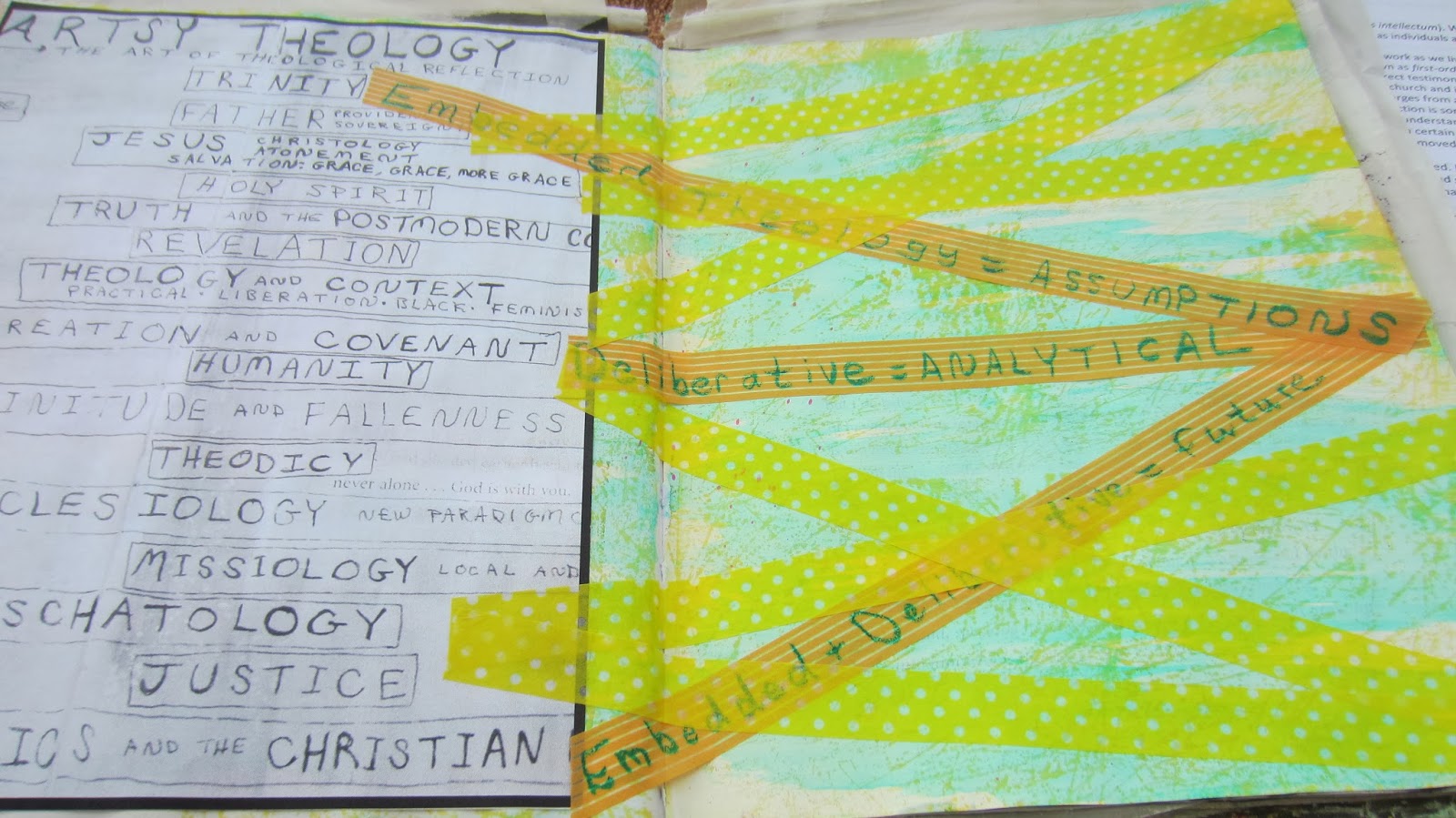
 I set out to illustrate (for myself) the reflective thinking process which connects themes like justice, mission, ethics, humanity, etc. with the process of theological reflection. The art journal page illustrates visually the frustration that someone new to the process of theological reflection realizes at a gut level: there is not clean-and-neat process for learning how to think theologically; just as there is not short-and-sweet process to "become" an artist. For both there are multiple layers which chris-cross back and forth. The suggestions for theological reflection methodology included here are from How to Think Theologically by Howard Stone and James O. Duke:
 Theological Method
1.       Where do you begin? [human/anthropological or divine]
2.       How do you proceed?
3.       How do you develop a theological template?
4.       How do you prioritize the issues of theology in their order of importance?
Two Modes of Thinking
1.       Sequential—linear thinking that gets one from A to B to C.
2.       Parallel synthetic thinking sees the total picture or Gestalt and the interrelateness of its parts.
For theology to be creative, the output of parallel synthetic thinking needs to be integrated with the conceptual constructs of sequential thinking and vice versa.
How Do We Begin—a Rudimentary Procedure
·         Examine the questions and struggles of our Christian lives.
·         Make explicit the theological understandings of the Christian message implicit in the discussion.
·         Examine those understandings and note their strengths and limits.
·         Propose what seems the most adequate resolution to the issue in light of the Christian message of God.
Ultimately: Explain in theological terms why what we propose is preferable to other options.

The Dream at 53

 I pasted "The Dream at 53" headline in my art journal four months ago and thought it would be interesting to see what I collected that represents my dreams of who & what I still want to be and do. The cartoon of the old lady at the bookshelf was the first thing I added: I knew beyond a shadow of a doubt that I would always be READING. The rest took more time and thought to accumulate and add. Some dreams are beyond my control (grandkids) and others
 required me to step aside from my doubts and fears and NAME that which I truly want to do. I added the eclectic collection of collage items over a four-month period, occasionally revisiting the page to reflect on my dreams. The ephemera includes photos, bits of my recycled art, stamping, washi tape, stencil, photographs, message from a fortune cookie, acrylic, and china marker. Perhaps the next step is to do an artsy theology entry on each dream on what will transform the dream to reality...


All Brings Joy

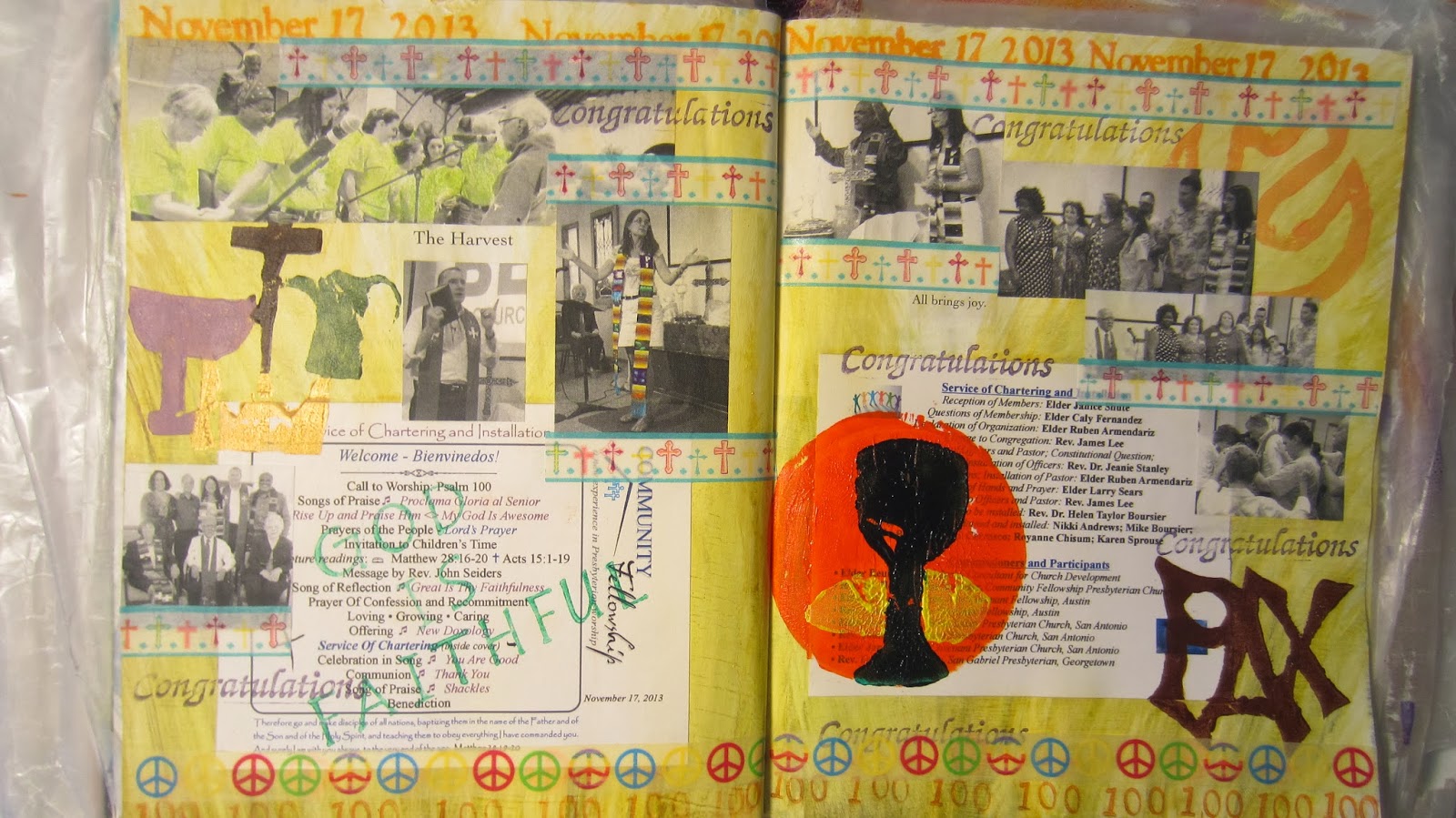
This messy collage is a compilation of memorabilia, block printing, washi tape, stamped lettering, photographs, and hand coloring with pencils and pastels. It captures the essence of a momentous event in the life of my congregation...and me.  
 The process of art journaling is an opportunity to "stop and smell the roses" instead of letting life bolt by. The celebration of charting the church (essentially an ordination service for a new church) occurred in the midst of one of the most intense pastoral care experiences of my ministry. I literally "sandwiched" the chartering service between a wake and funeral for a teenage boy who died after an altercation at school. The joy of the chartering celebration was a joy...but it got a bit lost in the intensity of the funeral.
Instead of closing the book on the JOY of November 17th, I re-opened the journal page and added a menagerie of art bits & pieces while reflecting and CELEBRATING all that God has done in the life of this little church that has now been recognized and blessed as a FULL MEAL DEAL BIG GIRL CHURCH. Art journaling is often not about the art...but about the process. Thanks be to God.

Abundance with Encaustics

 Background prep: white gesso in an altered book. Smudge on several colors of Inka Gold Metallic Rub. Add a layer of pretty paper. Cut out a watercolor flower from another piece of art paper and layer on top. Edge the page with washi tape. Now: time to experiment with encaustic wax. Begin by coating the pages with a layer of clear wax/encaustic.
 This is the "disappearing tissue paper" technique in Encaustic Workshop by Patricia Baldwin Seggebruch. Draw a design with very soft pastels on a piece of tissue paper cut to the appropriate size. Layer it on the pre-coated (with clear wax) page and seal with a heat gun. I added encaustics on top of the watercolor flower and fused the wax with a heat gun. During the art process of I had been thinking about my prayer for our son & daughter-in-law. I kept thinking "abundance" but I waited and listened, and prayed, and I realized that my prayer for abundance for this is peace, hope, and love. I added a second "disappearing tissue paper" with the words "Peace Hope Love."
 Then I stenciled "abundance" into the wax with a graphite pencil.


Index of Ideas


An index on the last two pages of an art journal helps ID themes & reflections.
 In one of my nearly completed altered book journals I tend to flip the pages back-and-forth looking for particular pages. While I was a passenger on a long road trip, I decided to make an index of ideas on the last two pages of the journal. First I used a post-it note on each page to give it a number and ID the main art themes. Then I took the total number of double-page-spreads (38) and divided that number by four to make columns. To ensure I saved the appropriate space for each index entry, I put a piece of washi tape for each position (plain masking tape would work also; but I used what I had on the road trip). With the spaces saved/masked, I sponge painted the background with watercolors on top of the previously laid down white gesso. Then I took each post-it note and wrote the page heading and materials & techniques used. Now I have an easy reference page to locate whatever art/reflection entry I'm looking for.
The washi tape "masks" out the space below.

The completed index.


Detail of the completed index.

Success/Good Intentions


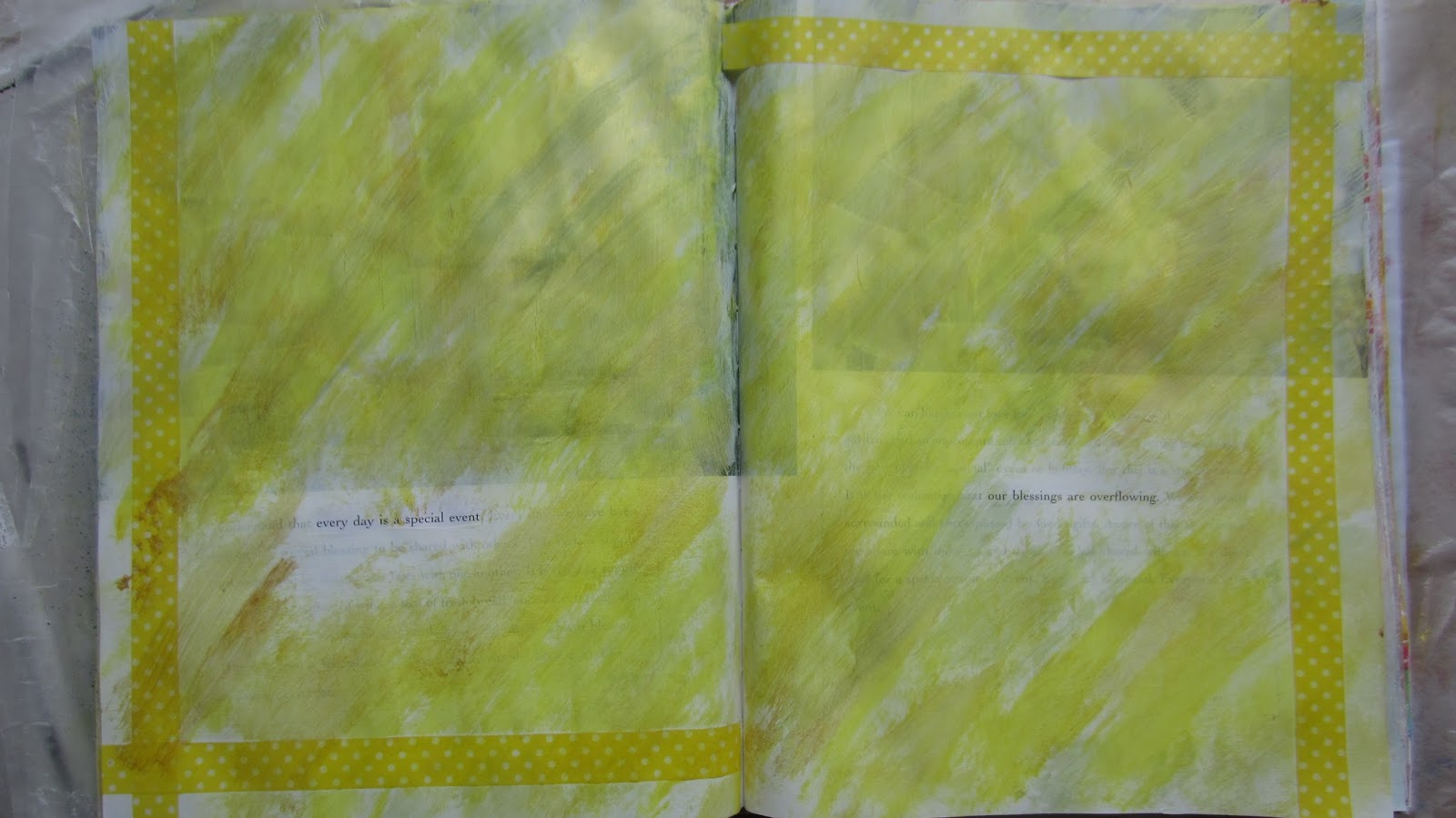
 The exposed words "success depends on more than just good intentions" was the catalyst to consider what the reality of my experience was compared to the ideal of my "good intentions." I identified the particular context (the nature and "being" of church) and the reflected on the so-called success of my ideals about the nature of church over-against (current) reality. It was helpful to define what has been going well and where the primary challenges continue to exist.

Bloom Where You Are Planted

Exposed words in an altered book provide a simple theme to reflect upon.
I used Sharpie oil-based markers to doodle and reflect on white gesso-covered pages. The purple mess can be covered later.
Use the end of a celery stalk as a "flower" block print.
 Lightly paint acrylic over the celery stalk and use it as a block print to decorate the edges and cover up the purple Sharpie marker that inadvertently "bled" on the page.
Rubber stamping and washi tape edge the double-page spread. A fun way to bring in color and design.
Go back and embellish some of your original lines to make create emphasis and also to have something to "doodle" while you are thinking and praying and listening to God.


Travel Light


 Prepping some background pages before a road trip means you can travel light with your art supplies. I painted white gesso on several pages in an altered book art journal and then did some fast prep with acrylic glazes and watercolors around exposed words and/or glued on words...something to spark reflecting thinking and creative art once I added some washi tape for easy pizzazz and rubber stamping on some pages. I'm on the road. I packed a small selection of colored pencils, travel-sized watercolors, and a variety of styles and widths of markers and pens. All the complicated and messy materials are staying home.