Showing posts with label watercolor. Show all posts

Timeline Reflection inside an Immigrant Family Detention Center

It is very frustrating for women in a family detention center to wait and wait and wait, wondering and worrying if they will be released and allowed to continue on to family (already) waiting for them in the U.S. or if they will be summarily deported back to the horrors of their homeland.It is particularly frustrating for those waiting while a family comes and goes but they are still waiting. The art reflection project I developed for the women was created with this frustration in mind. For the timeline project, their goal was to see how short their time is in the detention center compared to the big picture of life.
They wrote their story on the bottom layer of the art about their experiences in the detention center: what activities they and their children did, what their living arrangements were like, classes they attended, school, etc. They are locked up and waiting, but there are many interesting and even fun activities to do for the others and the children. The point was to name the blessings amidst the waiting.

They then painted over the words with watercolors and added stencils of symbolic shapes for their life (past, present, or future) using tempura or acrylic paint. The timeline is a piece of pretty art tape and it was placed halfway to represent the medium or average experiences in life. I asked the women to estimate how long they thought they would live and to put that number on the far right of the timeline. Most said they expected to live to age 100; a few said age 80. The average age of the participants was 22-25, and the timeline helped give the perspective that there is much more of their live to live before them then what has already been lived. In the big picture of life, "now" at the detention center is very short.

They put dots above the taped middle line for events in their lives that were good, and dots below the taped line to indicate event that were unhappy. They could add words to explain those dots or they could leave them blank. A stencil or stamp of a mother and/or a child to symbolically added their family into the art. They could glue on the Serenity Prayer and a scripture verse of the "fruits of the Spirit" if they wanted. The final touch: write the "fruit of the Spirit" that you most need to help you through this time of waiting. PATIENCE was the popular choice!

Timeline: Mixed Media Reflection on the Big Picture of Life (Bilingual)


Primero: Utilice un bolígrafo o un lápiz y escribir cuente su historia de estar aquí. ¿Cuándo llegaste? ¿Cuántos días llevas aquí? ¿Cuándo se espera que salir? Lo que ha estado sucediendo han estado aquí? ¿A qué te dedicas? ¿Qué hacen tus hijos? ¿Qué es un día típico en esta lista? En el panorama general de la vida: ¿Cuánto tiempo has estado aquí en comparación con la cantidad de tiempo que pasará viviendo GRATIS tu vida? Escribe tanto o tan poco como desee. Luego pintar el fondo con acuarelas. Añadir 1 o 2 colores de acento.
First: Tell your story of being here. When you came? How many days have you been here? When do you expect to go? What has been happening have been here? What do you do here? What do your children do here? What is a typical day like here? In the big picture of life: How long have you been here compared to the amount of time you will live your whole life? Write as much or as little as you like. Then paint the background with watercolors. Add 1 or 2 accent colors.

Segundo: Elija una plantilla y usar pintura acrílica o tempura para cubrir el fondo. En la muestra, los árboles simbolizan la dificultad en ver (a través de los árboles) para el futuro. La misma plantilla se repitió cuatro veces. Limpie la plantilla con una toallita de bebé. Utilice el secador de pelo para secar la pintura.
Second: Choose one stencil and use acrylic or tempura paint to cover the background. In the sample, the trees symbolize the difficultly in seeing (through the trees) to the future. The same stencil was repeated four times. Clean the stencil with a baby wipe. Use the hair dryer to dry the paint.
Tercero: Use cinta bonita para poner una línea de medio campo por el centro. La línea representa la media. Por encima de la línea es buena; debajo de la línea es mala. Calcule cuánto tiempo esperas para vivir. (La muestra pone a luz en el extremo izquierdo y 80 años de edad en el extremo derecho.) Crear una línea de tiempo de los buenos y malos momentos en su vida desde la infancia hasta el presente. Utilice una pluma de tinta y escribir los buenos y malos momentos de su vida desde la infancia hasta la actualidad y luego conectar los puntos. Piense acerca de cómo Dios ha estado presente en su vida.
Third: Use pretty tape to put a line halfway through the middle. The line represents average. Above the line is good; below the line is bad. Estimate how long you hope to live. (The sample places birth on the far left and age 80 at the far right.) Create a timeline of the good and bad moments in your life from childhood to the present. Use an ink pen and write down the good and bad moments of your life from childhood to the present then connect the dots. Think about how God has been present in your life.

Cuarta: escritura pegamento y / o la Oración de la Serenidad. Añadir plantillas o sellos para representar a usted ya sus hijos. ¿Qué fruto del Espíritu Santo que necesita para ayudarle? Escríbelo. Añadir sellos y figuras de papel cortado.
Fourth: Glue scripture and/or the Serenity Prayer. Add stencils or stamps to represent you and your children. Which fruit of the Holy Spirit do you need to help you? Write it down. Add stamps and cut paper shapes.


Identifying, Naming and Listing


Sometimes a journal entry can be as simple as identifying, naming and listing ________ whatever it is that relates to whatever is burning on your heart. It could be a career goal, a relationship issue or a (possible) life change. Take an already begun background and begin identifying and naming and listing.
I liked the simple prompt of a stamped image on "prayer" as the stamp reminded me that I have, in fact, prayed much about a given topic. The question was t prayer but response/action based on (much) prayer. 
I was hanging out in an airport waiting for a flight with my art journal and a single stencil. I opted to reflect on (previous) prayer and identify the necessary action steps. The beauty of stenciling words is the slow and reflective process required. It isn't fancy art journaling, but it provides an important reflective layer. 

Art Journal Do-Over

The beautiful thing about art journaling is the wonderful product: gesso. If you don't like a page for whatever reason glop on the gesso and call DO OVER!
I'd been taking notes as sermon prep. I didn't like the notes I'd been putting down (& I hadn't like the too dark stenciling background that I was doing the note taking on). I called do over & covered the page with white gesso; added some watercolor stencils and started all over again. 
The shadow of notes were still there but otherwise it was a fresh page and a definite do over. 

Rubbing Plates with Oil Pastels and Watercolors

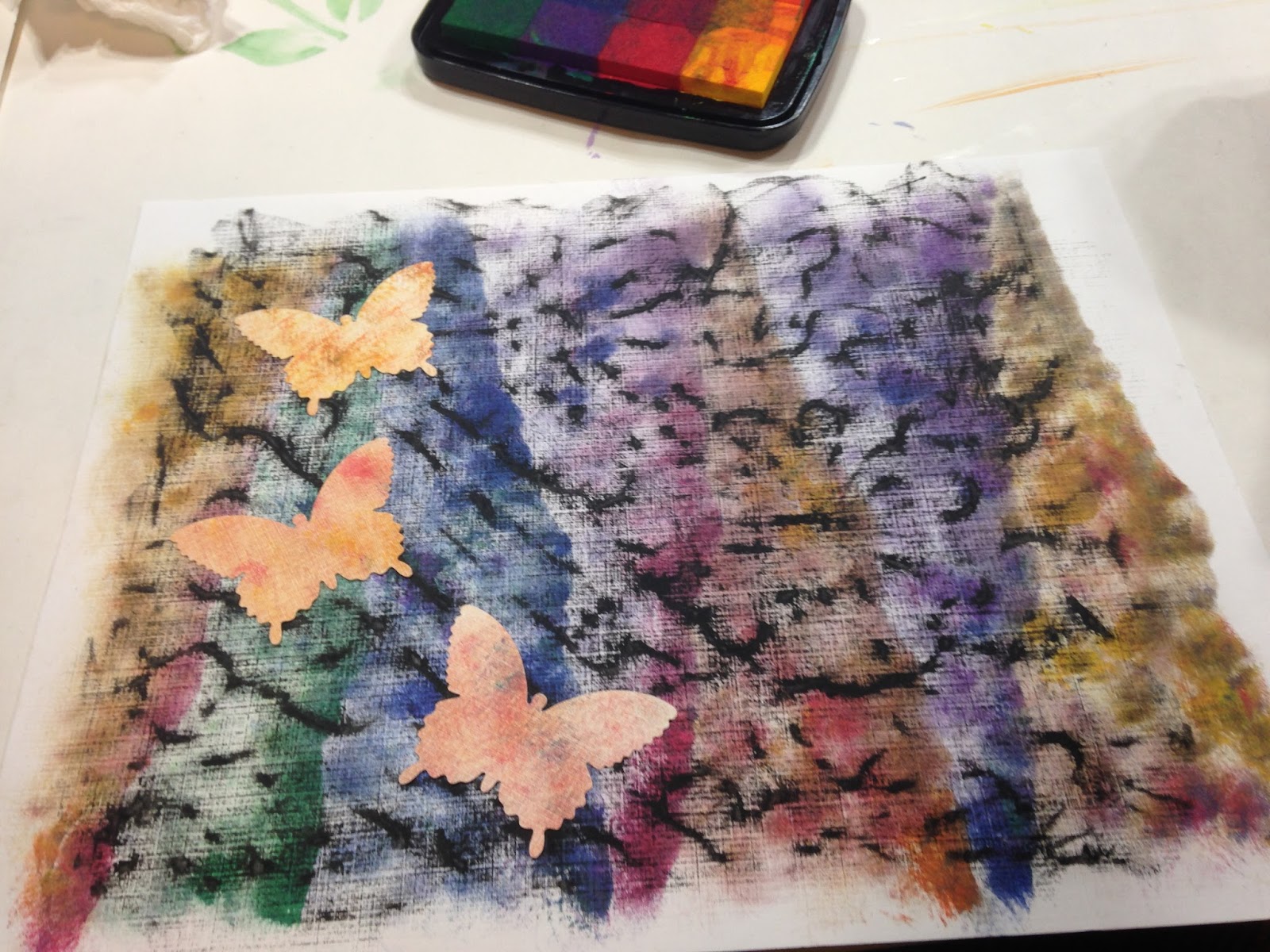
We had an afternoon of experimenting with rubbing plates, oil pastels (or crayons) and watercolors. I had made what I thought would be a tool for mono printing. I used thick acrylic medium on a piece of corrugated cardboard and pressed it with various stencils to created a textured surface. Once it dried, I had expected to use it to create impressions on a Gelli Art printing plate. It did not work out well because the dried acrylic was no porous enough to create the deep impression needed for mono printing. An artist friend transformed my "failure" into a great success by using it as a rubbing plate. She peeled the paper off of a black oil pastel, placed a thin piece of watercolor paper over the plate and then rubbed the oil pastel on the paper to create the textured effect. What hadn't worked well for mono printing created a beautiful rubbing. The rubbings were then painted with watercolors. 
Rubbing plate on left; rubbed image on right.


Quien Soy? (Who am I?) Immigrant Art Examples of Completed Reflections


 Women and children inside a family detention center created these mixed media reflections on the theme: Who am I?
Art tools and supplies.

Instructions for continuing the work once the initial "dumping" has been done: Use your favorite colors that remind you of home to cover the page with watercolors. Chose 3-4 words that best describe your hopes and dreams and future and write these very bold across the middle of the page. Use the art supplies to tell the story of who you are. Choices include: a big choice of stencils in many different shapes and sizes, foam stamps in shapes and letters, rubbing plate to add texture, punch tools to cut out shapes from pretty paper to then glue on your page, and letters as stickers you can use to spell your name or where you are from. Put your name and today’s date on the front or on the back.
A woman read her story to friends before she added more art layers.


Quien Soy? (Who am I?) Bilingual Instructions

"Quien soy?" is ministry of presence mixed media exercise for reflection to create a guided conversation on about the key elements of what defines/shapes one's sense of self. The concept is modeled after the Buddhist tradition to examine the question "Who am I?" It is particularly relevant for immigrants in detention to reflect on what shapes who they are. It is important to have a sample prepared and a bi-lingual teaching sheet. The English is for  staff or volunteers who are not fluent in Spanish (myself included). Ideally, it is best to have step-by-step photos which show the process of the layering. If multiple pictures/steps are not available as visuals, then have one sample of a completed example. The teaching instruction is included below.
Created by an immigrant mother inside a family detention center.
Quién Soy? Un Mixta Reflexión Media Art (en la tradición budista)
Who Am I? A Mixed Media Art Reflection (in the Buddhist Tradition)
I used my "Who and I?" art journal entry as the sample for Quien soy?
Primero: Utilice lápiz, crayón o pent tinta para llenar la página con palabras o frases que responden a la pregunta: Quién soy? Por ejemplo algunos temas a considerar: edad, sexo, raza, nacionalidad, orden de nacimiento ( hermano mayor ), el estado civil , las víctimas de la violencia, profundamente amado por mi madre, de grado en la escuela, idiomas que hablas, relación de miembros de la familia ( tía, sobrina, primo ), las creencias religiosas, los inmigrantes en busca de asilo, etcétera.

First: Use pencil, crayon, or ink pent to fill the page with words or phrases that answer the question: Who am I? For example some topics to consider: age, gender, race, nationality, birth order (oldest brother), marital status, victim of violence, deeply loved by my mother, grade in school, languages you speak, relationship to family members (aunt, niece, cousin), religious beliefs, immigrant seeking asylum, et cetera.

Segundo: Usa tus colores favoritos que le recuerdan a casa para cubrir la página con acuarelas.

Second: Use your favorite colors that remind you of home to cover the page with watercolors.

Tercero: Elija 3-4 palabras que mejor describen sus esperanzas y sueños y futuro y escriben estas muy intrépida a través del medio de la página.

Third: Chose 3-4 words that best describe your hopes and dreams and future and write these very bold across the middle of the page.

Quarto: Utilice los materiales de arte para contar la historia de lo que eres. Las opciones incluyen: una gran variedad de plantillas en muchas formas y tamaños, sellos de espuma en formas y letras, frotando la placa para añadir textura, ponche herramientas para cortar formas de papel bonito para luego pegar en su página, y las letras como pegatinas que puedas utilizar para deletrear su nombre o de dónde eres. Ponga su nombre y la fecha de hoy en el frente o en la espalda.


Fourth: Use the art supplies to tell the story of who you are. Choices include: a big choice of stencils in many different shapes and sizes, foam stamps in shapes and letters, rubbing plate to add texture, punch tools to cut out shapes from pretty paper to then glue on your page, and letters as stickers you can use to spell your name or where you are from. Put your name and today’s date on the front or on the back.

Thinking Time


Art journaling creates space for thinking time. I don't see art journaling as being about "good" art or "good" journaling. It's about creating a time and place and space to reflect and listen and discern.
I glued a symbolic photo of "me" onto an already prepared journal page. I choose the photo because of the subject's confident sense of self. I chose the prepared background because I like it (no more complicated than that). I added layers of stenciling and thought about who I am and whatever I might be going. 
On the symbolic words and symbols included here: tree (of knowledge); windows (to knowledge); gibberish words (discerning); knowledge; education. 
I added some journaling with my (surprise) insight to stay put andale where I am...work!

Who Am I? (Bilingual Instructions for Mixed Media Reflection)


Mixed media reflection of an immigrant mother seeking asylum.
Quién Soy? Un Mixta Reflexión Media Art (en la tradición budista)

Who Am I? A Mixed Media Art Reflection (in the Buddhist Tradition)

Primero: Utilice lápiz, crayón o pent tinta para llenar la página con palabras o frases que responden a la pregunta: Quién soy? Por ejemplo algunos temas a considerar: edad, sexo, raza, nacionalidad, orden de nacimiento ( hermano mayor ), el estado civil , las víctimas de la violencia, profundamente amado por mi madre, de grado en la escuela, idiomas que hablas, relación de miembros de la familia ( tía, sobrina, primo ), las creencias religiosas, los inmigrantes en busca de asilo, etcétera.

First: Use pencil, crayon, or ink pent to fill the page with words or phrases that answer the question: Who am I? For example some topics to consider: age, gender, race, nationality, birth order (oldest brother), marital status, victim of violence, deeply loved by my mother, grade in school, languages you speak, relationship to family members (aunt, niece, cousin), religious beliefs, immigrant seeking asylum, et cetera.

Segundo: Usa tus colores favoritos que le recuerdan a casa para cubrir la página con acuarelas.

Second: Use your favorite colors that remind you of home to cover the page with watercolors.

Reading her reflection to other immigrant mothers seeking asylum.
Tercero: Elija 3-4 palabras que mejor describen sus esperanzas y sueños y futuro y escriben estas muy intrépida a través del medio de la página.
Expressing pain through art and words.

Third: Chose 3-4 words that best describe your hopes and dreams and future and write these very bold across the middle of the page.
 
Quarto: Utilice los materiales de arte para contar la historia de lo que eres. Las opciones incluyen: una gran variedad de plantillas en muchas formas y tamaños, sellos de espuma en formas y letras, frotando la placa para añadir textura, ponche herramientas para cortar formas de papel bonito para luego pegar en su página, y las letras como pegatinas que puedas utilizar para deletrear su nombre o de dónde eres. Ponga su nombre y la fecha de hoy en el frente o en la espalda.
 

Fourth: Use the art supplies to tell the story of who you are. Choices include: a big choice of stencils in many different shapes and sizes, foam stamps in shapes and letters, rubbing plate to add texture, punch tools to cut out shapes from pretty paper to then glue on your page, and letters as stickers you can use to spell your name or where you are from. Put your name and today’s date on the front or on the back.

Reflection on the Theology in Genesis


An assignment for a university course I'm teaching this summer on the Old Testament includes the requirement to produce an AV that tells the story of the Old Testament in 5-7 minutes. I'm doing the project simultaneously with the class.
I've included symbols that tell key stories: elements of creation; an Apple on the tree of life and "choose" signifying free choice; ABC stenciling and the Tower of Babel; rainbow and God's promise to Noah not to flood the earth again; stars (upper right) for Gid's promise to Abraham that his descendants would be as numerous as the stars; stenciled circles (bottom right) for the abundance of the offspring now living in Egypt. 

Stacked Journalng on a Mission Trip

Messy handwriting looks FAB with stacked journaling.
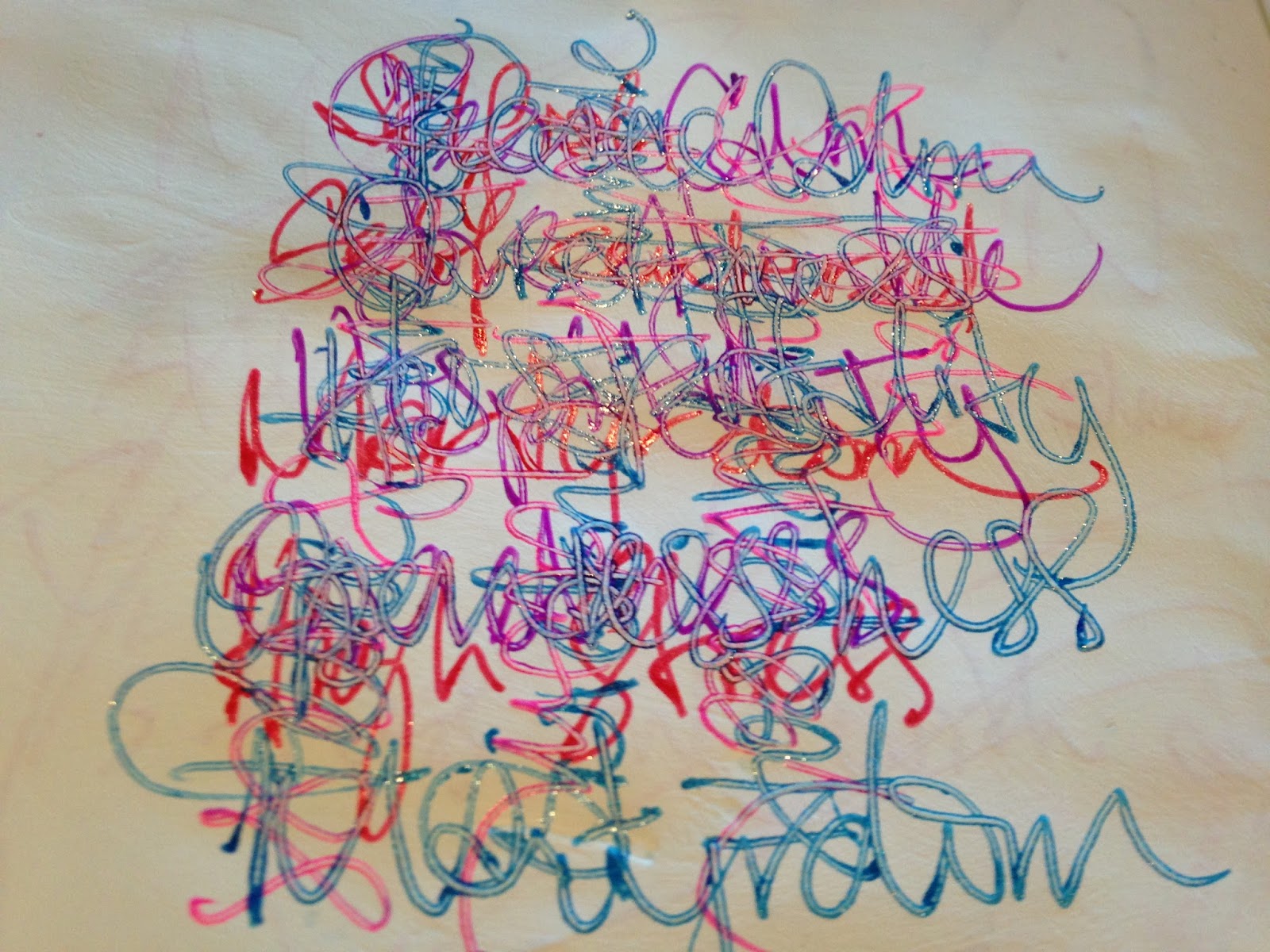
The art technique called "stacked journaling" is an excellent tool for journaling on a mission trip. The technique is writing on top of writing with the point to dump out feelings and emotions and experiences that you don't necessarily need (or want) to re-read later. The tools required can be very simple (i.e., watercolors and pencils or markers) or every elaborate (i.e., incorporating virtually any and all media). We used stacked journaling as a team debrief after a particularly hectic day in the mission field. There is no need for "show and tell" as the art is meant to be self-expression of the moment, day, event, or place.
Layers and layers of neat and tidy writing also works well.

No rules with stacked journaling...just write on top of writing on top of writing.
Team art journaling after a day in the mission field.

King of Kings Crowns for VBS art in a Colonia en Cabo San Lucas

Supplies: watercolors, crayons, brushes & cups for water.
After teaching local leadership how to do wax resist to make crowns, these trained leaders showed children in a colonia in Cabo San Lucas, Mexico how to make the crowns. The teaching theme was Jesus as King of kings (Rey de reys) and Prince of Peace (Principa de Paz). First the children learned a catchy song in Spanish (we didn't quite get to the English which really adds a nice touch when there's time to teach in bilingually). Then the teachers led the children in making the crowns while the women learned how to make earrings for cottage industry skills. The artful crowns were a big hit. Much fun enjoyed by all.


Cabo Church Art Workshop Mixes Art with Theology

Integrating mixed media art in Christian education is an excellent way to help students of all ages embody the lesson through simple art techniques which are easily taught and require simple supplies. Art makes learning much more fun! There are almost unlimited projects you can create that use stencils and stamps. Once you have the basic tools (stencils and stamps), the art continues into infinity. An easy project is to talk about symbols and shapes and how they add meaning to people, places, and events. The art experience helps people to visually connect with the key themes of a particular (biblical) teaching.
Lynn creates layers of meaning with stencils, stamped images and crayon
Lynn working on layers.
Stamped images add interesting layers to art.


No fancy set-up required: art supplies scattered down the middle and GO.